Farne Islands
Boat trips from Seahouses harbour visit islands cared for by the National Trust, known for puffins in late spring and early summer and for grey seals. Sea conditions can cancel trips at short notice.
The best seaside memories often come from a small find: a shore crab under a stone, a curl of ammonite, the clatter of a pier on a windy day. These activities suit a range of ages and most work whatever the weather is doing.
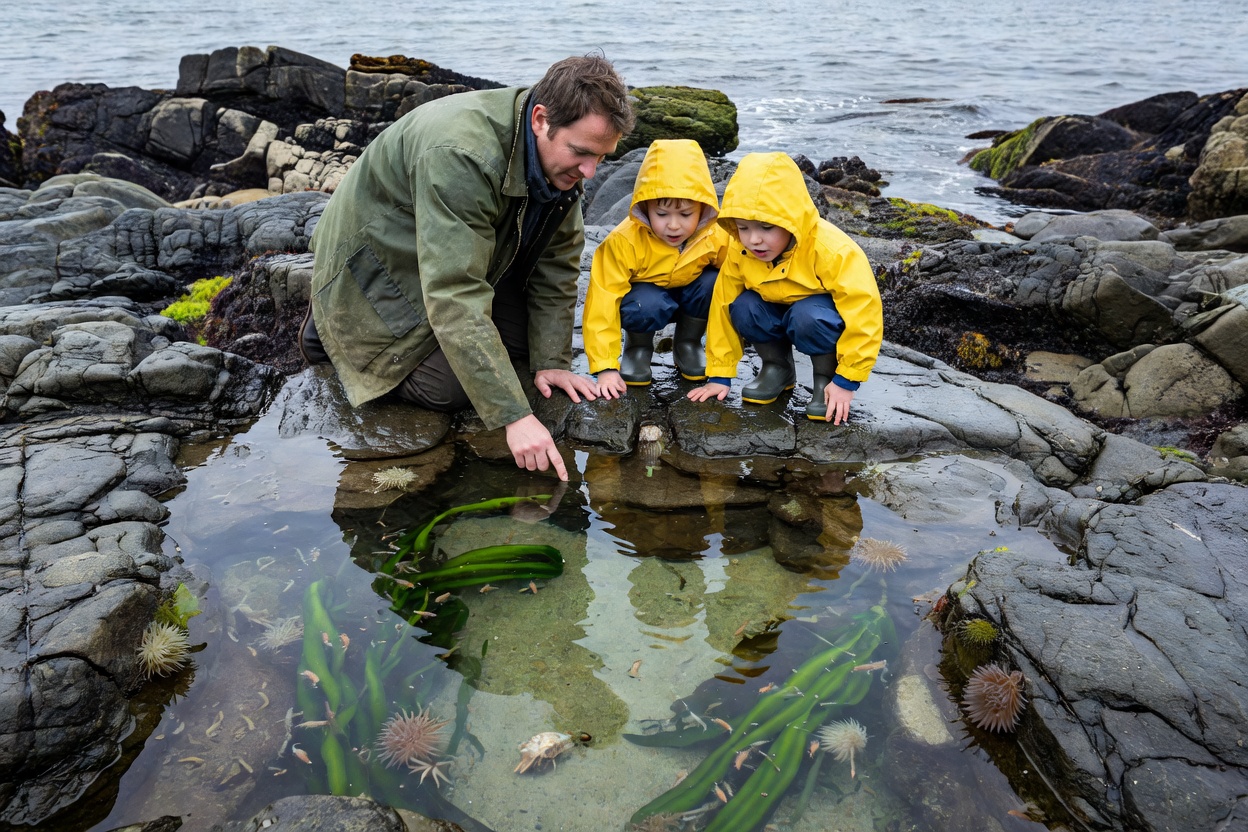
Rock pools are free, endlessly varied and right at a child's eye level. Good spots include the rock scars at Robin Hood's Bay, the ledges around Wembury in Devon and the reefs near Kimmeridge Bay in Dorset. Go on a falling tide and leave well before it turns.
The Wildlife Trusts' Seashore Code is worth sharing with children: look carefully, handle gently with wet hands, put creatures back where you found them and return every rock the right way up. Buckets are best used briefly, in the shade, with seawater.
The Jurassic Coast between Exmouth and Studland is one of the best places in the world for young fossil hunters. At Charmouth, the Charmouth Heritage Coast Centre on the seafront explains what you might find, and guided fossil walks have long been part of local life. Lyme Regis, home of the pioneering fossil collector Mary Anning, is close by.
The golden rule is to search the loose material on the beach, especially after winter storms, and never dig into or shelter under the cliffs. The cliffs here are unstable and falls happen without warning. A falling tide gives the safest, widest search area.
Remember: a fossil is never worth climbing for. Stay back from the cliff base and keep children with you.
A line, a weight, a mesh bag of bait and a bucket of seawater can keep children happily occupied for an hour. Walberswick on the Suffolk coast, by the River Blyth, has a long crabbing tradition, as does the quay at Wells-next-the-Sea. Use crab lines rather than hooks, keep the bucket out of the sun, don't overcrowd it, and gently return the crabs close to the water's edge rather than dropping them from height.
Quaysides have edges and fast-moving water, so this is an activity for close supervision, with smaller children kept well back.

Home to Tim Hunkin's Under the Pier Show, a collection of quirky handmade coin-operated machines that charm all ages.

A huge castle on a rock above the beach, ideal for combining sand with history.

Clifftop ruins cared for by English Heritage, reached by the famous 199 steps or by road.

Big grassy spaces and views over both bays, a good plan B on a breezy day.
Britain has some of the world's great coastal trails. The South West Coast Path runs around 630 miles from Minehead to Poole Harbour, and the Wales Coast Path, opened in 2012, follows almost the whole Welsh coastline. You don't need to walk far: a mile or two between a car park and a café, or a loop that returns along the beach at low tide, is plenty for young legs.
Choose sections with a fence or wide margin from the edge, keep dogs and children on the landward side and turn back if wind picks up. Many paths are uneven and unsuitable for buggies, so a sling or carrier is easier for babies.
Boat trips from Seahouses harbour visit islands cared for by the National Trust, known for puffins in late spring and early summer and for grey seals. Sea conditions can cancel trips at short notice.
If you see a seal resting on a beach, keep well back, keep dogs on leads and never try to return it to the water. Disturbance is stressful for them.
Estuaries and saltmarsh, such as those along the North Norfolk coast, are wonderful for spotting wading birds. A pair of binoculars turns a grey day into a treasure hunt.
Pair any of these with the right kit using our preparation checklists.